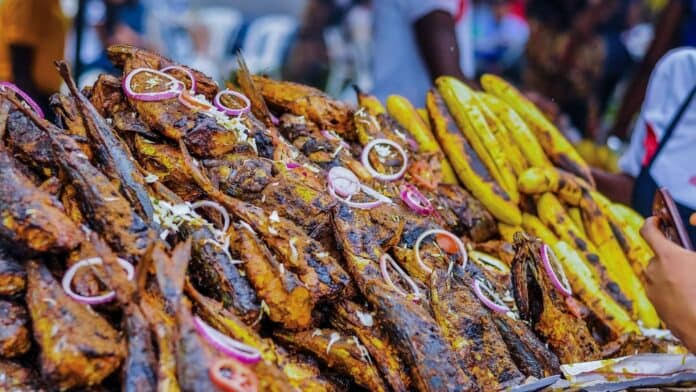
There are foods that fill your stomach, and then there are foods that fill your soul. In Port Harcourt, bolé and fish it will do both and it does by the side of the road, sauce dripping from the bowl in your hands, with smoke still rising from the grill.
If you have ever lived in, visited, or even passed through Port Harcourt, you already know. Bolé is not just food. It is an experience.
What Is Bolé & Fish?
At its heart, bolé is roasted plantain firm, unripe or semi-ripe, slow-roasted over an open charcoal fire until the skin is charred and the inside is soft, smoky, and slightly sweet. It is paired with roasted or smoked fish typically the star being “Titus fish” the Atlantic mackerel roasted or smoked to perfection over the same hot coals. and the whole thing is brought to life with a pepper sauce that deserves its own paragraph.
The sauce. Oh, the sauce.
It is a bold, fiery blend built on a palm oil base, loaded with ground pepper, crayfish, onions, and seasoning. It is not shy. It is not subtle. It coats every bite of plantain with heat and flavour that lingers long after the meal is done. Sliced fresh onions and garden vegetables are often layered on top, adding crunch and brightness to what is already a deeply satisfying plate.
Why Port Harcourt Claims It
Many Nigerian cities have roasted plantain. But Port Harcourt has made bolé its own. Here, it is a ritual. You find it on major streets, at evening markets, outside offices, beside petrol stations anywhere a charcoal grill can fit and hungry people gather. The aroma alone is enough to make you stop your car.
PH people are particular about their bolé. The plantain must have the right ripeness not too soft, not too starchy. The fish must be freshly roasted, not reheated. The pepper sauce must have depth. Shortcuts are noticed and judged accordingly.
This pride in the dish runs so deep that Port Harcourt hosts the annual Bolé Festival a full celebration dedicated to this one iconic street food, drawing food lovers, vendors, and culture enthusiasts from across the country. It is proof that bolé is not just a meal here. It is identity.
The Experience of Eating It
There is something deeply communal about eating bolé by the roadside. You stand near the grill, watching the vendor expertly turn the plantains over hot coals, the fish sizzling beside it. The sauce is scooped generously into a bowl, poured over your plantain and fish. You eat with your hands, scooping from the bowl, the sauce pooled at the bottom, with the noise of PH traffic as your background music.
No cutlery required. No dress code. No reservation.
It is the great equalizer the executive and the mechanic standing at the same grill, eating the same thing, equally satisfied.
Where to Find the Best Bolé in PH
Ask any Port Harcourt person and they will tell you the best bolé is always “near my area.” But some spots are legendary: along Rumuola Road, around Mile 1 and Mile 3 markets, and the evening spots along Peter Odili Road where the smoke rises as the sun goes down.
The best time to eat bolé? Late afternoon, when the coals are at their hottest and the vendors are in full flow.
Bolé and Fish is Port Harcourt on a plate bold, unpretentious, unapologetically flavorful, and utterly irreplaceable. If you have never had it fresh off a PH roadside grill, you have a trip to plan.
And if you have you already know exactly what we mean.
Know a bolé spot in Port Harcourt that deserves recognition? Drop it in the comments. Let’s keep the list going.



0 Comments